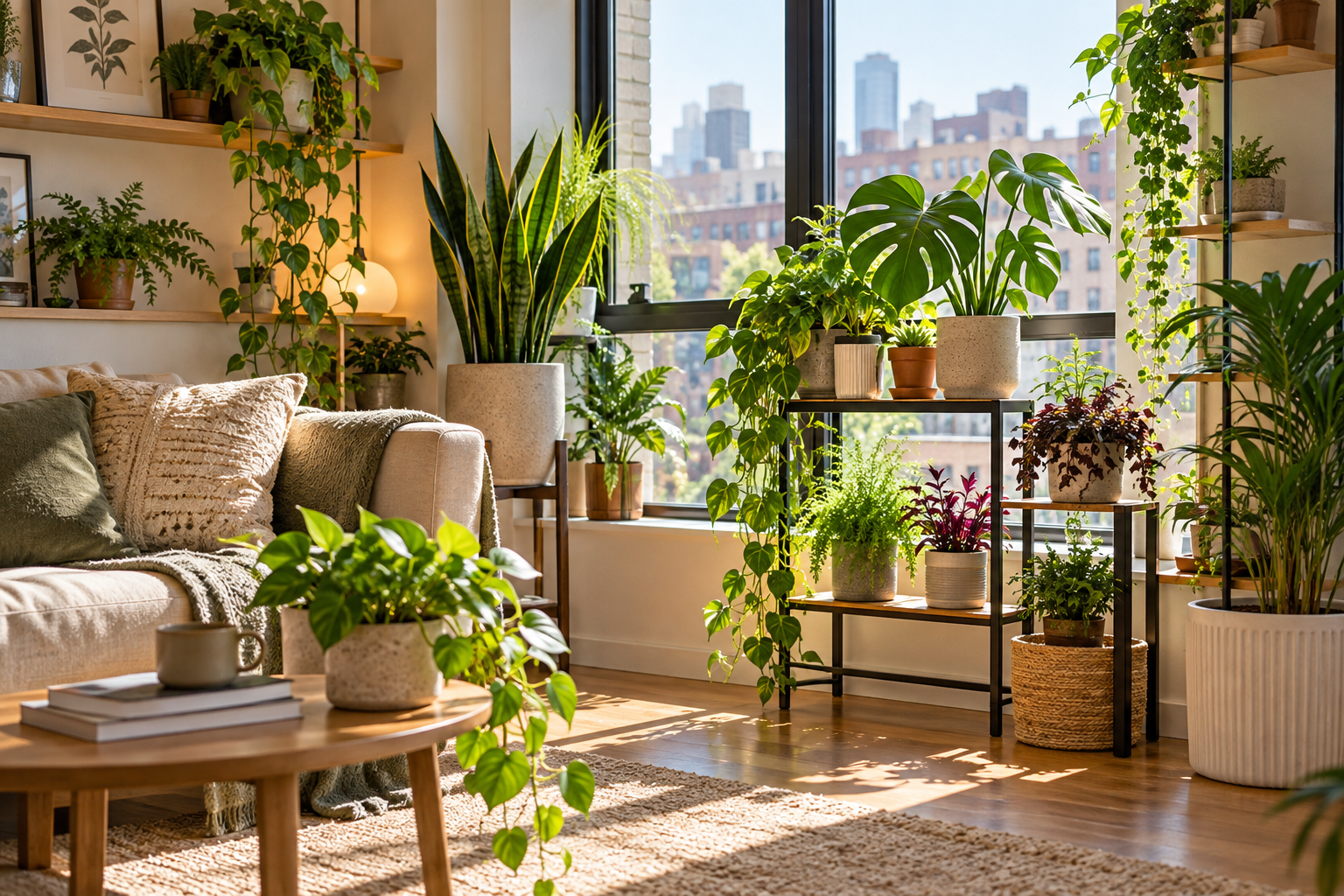
Apartment gardening gets easier when you stop asking “Which plant should I buy?” and start with a better question: “What will actually work in this space?” In a small home, usable light, floor area, watering habits, pets and container weight matter more than the size of the room on a floor plan.
Use this guide as a map: identify the constraint that matters most in your apartment, then jump to the guide that deals with it in detail.
Start with the place, not the plant
Pick the location before the species. Stand where the plant will actually live and look at four things: usable daylight, available footprint, access for watering and the consequences of a spill or a heavy pot. A beautiful plant in the wrong location becomes a maintenance problem; a well-matched plant can add greenery without making a small room feel crowded.
1. Work out how much usable light you really have
Window direction is useful, but it is not enough. Nearby buildings, balconies, trees, tinted glass and the distance from the window can change the amount of light reaching a leaf. Judge the exact spot at plant height, not how bright the room feels to you.
If you want to replace guesswork with a real number, use our guide to measuring light for houseplants with a phone, lux meter or simple shadow test.
If the space is dim but still receives meaningful daylight, start with our guide to low-light plants for small apartments. If you are still choosing among several locations, our broader indoor plants for small apartments guide compares compact choices by growth habit, watering and placement.
2. Treat footprint as a design constraint
Small-space gardening is not about collecting only miniature plants. It is about using growth habit to make better use of shelves, corners, walls and floor space.
- Desk or narrow shelf: compact plants that stay reasonably small.
- High shelf or hanging position: trailing plants that keep foliage off the floor.
- Narrow floor zone: upright plants that create height without a broad canopy.
- Plant stand: useful when the plant needs visual height, not a larger pot.
Think vertically before adding more floor-level containers. A few plants distributed across different heights usually feel calmer than the same number competing on one windowsill.
3. Match the pot to the room as well as the roots
In an apartment, a container has extra jobs. It must manage drainage without damaging floors or furniture, remain stable in walkways, and be movable when light changes or the room needs cleaning. Oversizing also adds wet substrate and unnecessary weight.
Our small-apartment pot guide walks through drainage, size, weight and space-saving placement. If you already know the plant and location, Find My Pot gives you a practical container-type starting point.
4. Build your watering routine around the conditions
A watering calendar is less useful than observing how quickly the growing medium dries. A plant in lower light generally uses water more slowly than the same plant in a brighter position. Pot size, material, indoor heating and air-conditioning also change the drying rate.
For a small collection, make the routine easy: keep plants accessible, avoid containers that hide standing water, and group plants with similar needs where that makes sense.
5. Put pet safety into the first decision, not the last
If a cat or dog shares the apartment, plant choice and placement need to be considered together. Hanging a plant higher can reduce access, but placement is not a substitute for checking whether the exact species is appropriate for your household.
Start with our pet-safe indoor plants for small apartments guide for a focused shortlist and the source checks behind it.
Choose your route
| If your main problem is… | Start here |
|---|---|
| You want the best all-round indoor choices | Best indoor plants for small apartments |
| Your apartment is dim | Low-light plants for small apartments |
| You live with a cat or dog | Pet-safe plants for small apartments |
| You are unsure about drainage, pot size or weight | How to choose pots for small apartments |
A 10-minute apartment plant audit
- Choose the exact spot where you want greenery.
- Observe daylight there at more than one time of day.
- Measure the usable width, depth and height.
- Decide whether the plant should sit, stand, trail or hang.
- Check how you will water and where excess water will go.
- Account for pets, children and narrow walkways.
- Only then shortlist the plant and container.
Where location and climate start to matter
For most indoor foliage plants, the room itself is the first environment to solve. Once plants move onto balconies, patios and terraces, geography becomes much more important: seasonal temperature, heat, wind, direct sun and local climate can change the recommendation completely.
For outdoor spaces, this means the same plant can be a sensible choice in one place and a poor one in another. Climate belongs in the decision from the start, alongside the plant and the container.
The simplest rule
Do not try to make the plant fit a photograph. Make the choice fit the real space. Start with light and placement, match the plant to those conditions, then choose a pot that supports the roots and the way you live.